The Behavior Layer Running Underneath Your AI Workflow
[Case Studies]
Where behavioral analysis closes the gap AI alone cannot
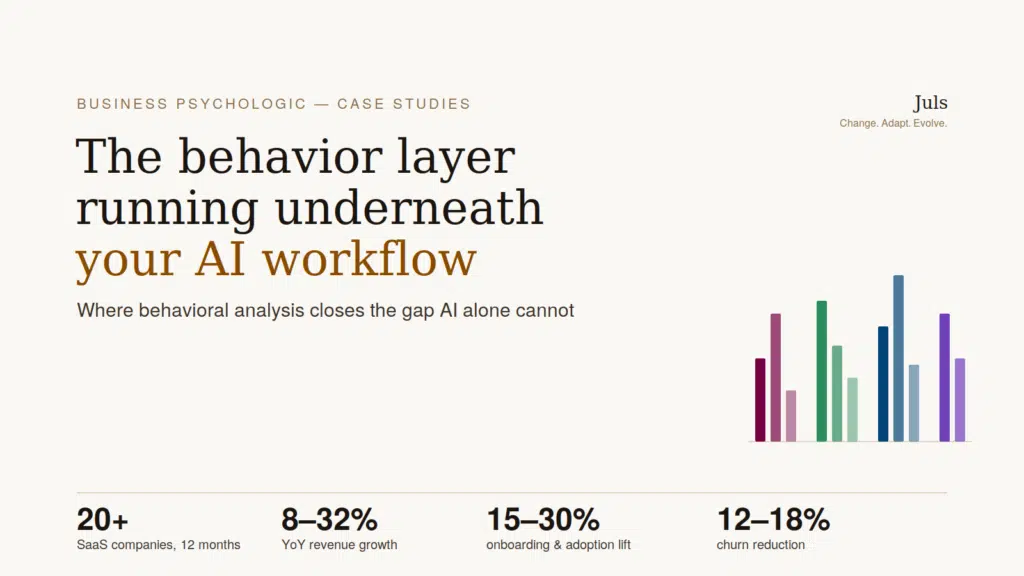
Over 15 years, across 150+ brands, I’ve watched the same pattern repeat. In the last 12 months alone, that work has spanned 20+ SaaS companies building AI into how they sell, onboard, and retain customers, contributing to 8 to 32% YoY revenue growth, 15 to 30% improvements in onboarding and feature adoption, and churn reduced by 12 to 18%.
Every engagement runs under NDA, so what follows is aggregated, not attributed. The pattern, though, is too consistent to keep to myself.
Building the AI workflow is the easy part now. The hard part is what happens after launch, when a real customer has to decide, again and again, whether to trust it, stay, and become the kind of power user every founder is chasing.
Behavioral analysis closes this gap by improving the customer’s decision-making via “people-product-market” fit.
It creates the psychological safety a customer needs to make an informed choice, instead of a hesitant or impulsive one. It tells you why people stall, where they disengage, and what actually earns their trust.
AI cannot do this on its own because it has no concern for human values, no instinct for wisdom, no felt sense of what safety means to the person on the other side of the screen. AI cannot predict the friction it creates during its own adoption, because it was never built to ask that question. That question is mine to ask. Explore some case studies to understand how Business Psychology can support your people-product-market fit.

Business PsychoLogic
Where vision meets actual execution
4-week reality gap discovery for founders who build with intention
CHANGE. ADAPT. EVOLVE.
#1. The AI Coach That Became a Threat, Not an Empowerment Tool
A sales SaaS built an AI that listened to sales rep conversations and delivered real-time coaching, advising reps on how to navigate the conversation and keep the prospect engaged. The intention was for it to feel like a supportive partner on every call.
The friction point in adoption and usage
It didn’t feel supportive. It felt watched. Reps were already under training pressure, and the constant monitoring and feedback increased their anxiety instead of easing it. The AI had been built around empathy and emotional tone regulation, on the assumption that warmth is the single biggest predictor of sales success. But for reps still building confidence in their role, that focus on emotional nuance created more confusion, not more safety. They didn’t know whether they were being coached or evaluated.
The transformation
We removed the deep psychological layer and redesigned the workflow around role specifics, tasks, and requirements instead. Rather than asking reps to manage their own emotional tone in real time, we shifted the model toward key account management practices, and removed the pitching pressure from the conversation entirely.
The AI now suggested structure: how to move through the conversation in clear phases, aligned to a negotiation framework, rather than prompting reps to manage feelings on the fly. Psychological safety came from clarity of role, not emotional performance. The emotional support shifted toward the prospect’s experience, not the rep’s internal state.
The results
With the role made explicit and the emotional burden removed from the rep, performance improved by 20% within the first months of the pilot. Adoption accelerated. Reps trusted the tool because it finally told them what to do, not how to feel.
#2. When the AI Couldn’t Hold the Whole Picture
A cluster of SaaS companies were building AI-driven workflows for human behavior at work (culture and team alignment, conflict resolution, internal dynamics, how people handle hard topics, how teams respond to difficult clients). Each SaaS approached behavior from a different angle, but they all hit the same three walls: small context windows, conversational design that lost depth too quickly, and the cost of running it all through tokenized AI calls.
The friction point in adoption and usage
The AI was trying to do too much inside the conversation itself. Gathering data, holding context, and protecting sensitive information all at once, inside a single AI-native flow. That created two problems together. The AI risked misrepresenting sensitive input, and there was no safety layer keeping personal data separate from the behavioral patterns the SaaS was actually trying to measure.
People didn’t trust what happened to what they shared, and the AI didn’t have enough room to go deep without losing the thread.
The transformation
We broke down the client journey and moved data gathering outside the AI workflow, before the conversation, not during it. That meant building structured frameworks upfront, so the AI wasn’t responsible for extracting and protecting sensitive information in real time.
We also built a safety layer separating personal identity from behavioral data. No names, no individual specifics inside the model. Only the aggregated signal of how the team or relationship was actually functioning.
The deeper work was building a framework that governed the behavioral analysis itself, one shaped around each company’s specific use case. We applied theories from different psychological fields to measure stable constructs and predict real human behavior patterns, the kind that shape a client journey, reveal team dynamics, surface leadership behavior, or flag churn and retention risk before it shows up anywhere else.
Every one of these companies depends on correctly reading human connection, behavior, thought, and emotion. That’s what lets them predict what a relationship is actually heading toward, not just describe what already happened.
The results
Each SaaS in this group ended up with a more reliable way to gather internal intelligence, grounded in validated constructs instead of whatever the AI happened to generate. Conversations went deeper, predictions held up, and every participant’s personal data stayed protected throughout.
#3. When the Behavioral Intelligence Stopped Telling the Truth
A different cluster of SaaS companies worked in consumer behavior analysis and leadership testing and coaching. On the surface they served different audiences, one focused on app stack and consumer behavior, the other on leadership assessment, but they ran into the same structural problems: unstable performance from the AI, no static report templates, and a tendency to generate generic, low-confidence output built on too many assumptions.
The friction point in adoption and usage
The reports weren’t actionable. They read like guesses dressed up as insight. Tokenization costs were unpredictable, performance wasn’t stable from one run to the next, and there was no consistent structure underneath the output, so every report felt like a different tool had written it.
On the consumer behavior side, the deeper issue was that the AI workflows had nothing stable to stress-test against. On the leadership side, the problem was trust in the data itself: client identity had to be matched correctly to survey responses, and sensitive personal information needed to stay isolated from the AI-native workflow, but neither of these were built in from the start.
The transformation
For the consumer behavior companies, we built a static framework that injects synthetic personas into the workflow, giving the AI something stable and repeatable to stress-test client dynamics against, instead of generating fresh assumptions every time. This applied across both structured and unstructured client data.
For the leadership assessment companies, we rebuilt the entire client journey and report template structure, then stripped AI out of the steps where it wasn’t actually needed.
We built a reliable identity-matching layer so each respondent’s context stayed correctly linked to them throughout, while keeping their sensitive personal data isolated from the AI workflow itself. And we rebuilt the scorecards using behavioral and statistical validation, so the constructs being measured were actually reliable, not just AI-generated impressions of reliability.
The results
Reports stopped reading as generic and started reading as evidence. With validated scorecards and a stable underlying framework, these companies saw better conversion from demo to paid, because for the first time, what the tool told a client about themselves actually held up.
#4. Where Trust Broke Before Churn Ever Showed Up
Across all of these SaaS companies, the business model itself was creating friction with customers and buyers. Getting people onto a pilot was hard enough. Getting them to actually trust the pilot, and what it would become, was harder.
The friction point in adoption and usage
The journey, the pricing tiers, and the core value proposition weren’t built around trust. They were built around acquisition. That meant onboarding and engagement were treated as a single moment instead of an ongoing relationship, and retention suffered as a result.
By the time churn showed up on a dashboard, it had usually been building for weeks. The signal was always there. Nobody had built a way to see it early.
The transformation
We redesigned the entire client journey: the tiers, the core proposition, and how it connected to GTM, marketing, and sales. Retention wasn’t treated as a downstream metric to fix later. It became part of how the journey was built from the start.
Alongside that, we developed stronger key account management practices specifically for onboarding and engagement, so the relationship had structure from day one instead of momentum that faded after signup. And we built internal AI-driven workflows that tracked behavioral signals and patterns in real time, designed specifically to predict churn before it became visible on any dashboard.
The results
Retention improved across every company in this group. Pilots converted with more confidence, onboarding felt like the start of a relationship instead of a formality, and churn risk became something these teams could see coming, not something they discovered after the fact.
#5. When Engagement Never Got Past the First Login
A different cluster of SaaS companies had a good product, but onboarding was either overcomplicated or unclear. The signal was the same every time: people weren’t engaging. And low engagement is one of the strongest predictors of churn there is.
The friction point in adoption and usage
Users weren’t disengaging because the product lacked value but because nobody had built a path to discover that value quickly enough. Onboarding asked too much, too soon, without showing people what they could actually do with the tool in their real workday. There was no early win, so there was nothing pulling them back in.
The transformation
We simplified the onboarding workflow down to what mattered: the core features and the basic actions that let someone experience a quick win early. Instead of front-loading complexity, we built a journey that gently introduced what was next, paced around small, achievable milestones.
We added structured elements of gamification, designed around celebrating those milestones and creating moments of self-reflection rather than empty rewards. The goal wasn’t to gamify for its own sake. It was to make people curious about the next step, while they were solving the actual problems in their workday.
The results
Each of these companies wanted the same outcome: to become a necessity, not an option. By making the early experience feel safe, simple, and a little joyful, users moved from trying the tool to using it daily, and from using it daily to depending on it.
People, Product, Market Fit: A Behavioral Summary
Across every case above, the pattern repeats. The product was rarely the problem. The gap between what founders believed was happening and what was actually happening, the Reality Gap, was.
True people, product, market fit isn’t a single milestone. It’s a journey, built in well-defined phases, that moves someone from non-buyer to power user. Each phase has its own psychological needs and its own friction points, and skipping any of them is usually where retention quietly breaks.
From curiosity to commitment
A non-buyer needs to feel safe enough to be curious. That means addressing objections before they’re spoken, not after. It means designing for someone who has no habits with your product yet, and won’t form any if the early experience asks too much, too fast.
From first use to daily habit
This is where Cognitive Friction shows up most. Structural leaks in onboarding, in messaging, in the gap between what was promised in the sales cycle and what the product actually delivers on day one, waste the trust a new user brought in with them. Trust-Cycle Calibration matters here: the psychological fit between how fast you’re asking someone to move and how fast they’re actually ready to trust you.
From habit to power user
Power users aren’t created by features. They’re created by emotional satisfaction, consistent small wins, and a system that respects their pace instead of forcing it. This is Behavioral Positioning in practice: whether your competitive edge is something the user actually lives, or just something your marketing claims. Underneath all of it sits Retention Proactivity, using real behavioral signal to see disengagement before it becomes churn, not after.
This is what business psychology contributes that AI alone cannot. AI can process the data. It cannot feel the hesitation behind a paused trial, the quiet loss of curiosity after week two, or the low emotional satisfaction that never gets typed into a feedback form. Closing the Reality Gap between vision and execution means designing for the human on the other side of every one of those phases, deliberately, not by accident.
Change. Adapt. Evolve.
Juls =)
Business PsychoLogic — for your growth.
Business PsychoLogic
Where vision meets actual execution
4-week reality gap discovery for founders who build with intention
CHANGE. ADAPT. EVOLVE.
💡 The Outcome for your business:
Systemic Autonomy
(The Exit-Ready Engine)
The business transitions from being “Founder-Led” to “System-Driven.” By codifying leadership intuition and decentralizing decision-making, the organization achieves a state where growth is no longer limited by the CEO’s personal bandwidth. This outcome maximizes the valuation of the company because the “knowledge” is an asset of the firm, not a prisoner of the payroll.
High-Fidelity Execution
(The Zero-Waste Model)
By closing the Reality Gap between GTM promises and operational flow, the business eliminates “Cognitive Friction.” The outcome is a drastic reduction in talent waste, lower client churn, and the removal of the “Hustle-Halt” cycle. Resources are shifted from fixing internal fires to aggressive market expansion.

Human-Centric Scalability
(The AI-Augmented Culture)
The integration of AI becomes a competitive moat rather than a source of team anxiety. The outcome is a High-Integrity Ecosystem where technology removes repetitive friction while humans focus on high-stakes empathy and complex strategy. This allows the company to scale its output and ROI without a linear increase in headcount or a decrease in quality.
If your business isn’t behaving as predicted,
the answer is in the human perceptions & behavior.






How to Plan Your Business Growth?
OUR PUBLIC RELATIONS:
Featured In & Our Official Partners

OUR CUSTOMERS:
Client Success Stories

We are proud of our 15-year track record of success. While we don’t achieve every goal, we’re relentless in pursuing excellence.

We are the innovators you need to turn your business idea into a market disruptor. Make your ideas stand out.

Confidentiality is key to our success. We work under strict NDAs to protect the data and competitive advantages of our clients.
OUR TEAM:
Who are We
OUR ARTICLES TELL REAL STORIES:
Business PsychoLogic Frameworks & Applied Tools
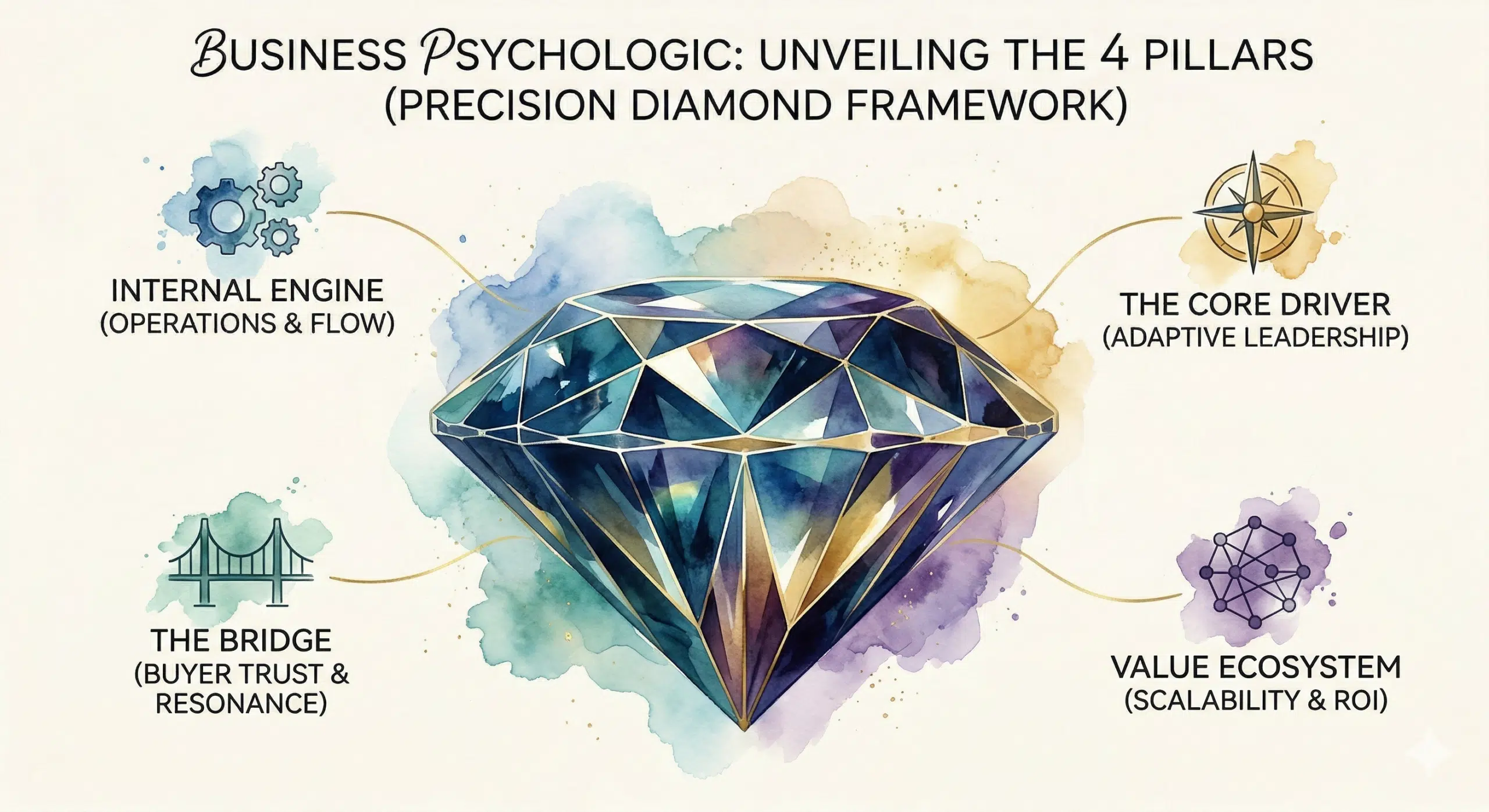
How to close the gap between your vision and the actual execution?
Most businesses do not fail because the strategy is wrong. They fail because the promise, the delivery, the leadership behavior, and the AI workflows do not line up. Business PsychoLogic…

Scaling the “Unscalable”: From 1 Room with 10 seats to a B2B Ecosystem 🚀 in 12 months
As we wrap up 2025, the entire team at Juls’ Psychology wants to wish you a season filled with peace, meaningful connection, and the courage to rest. This time of…
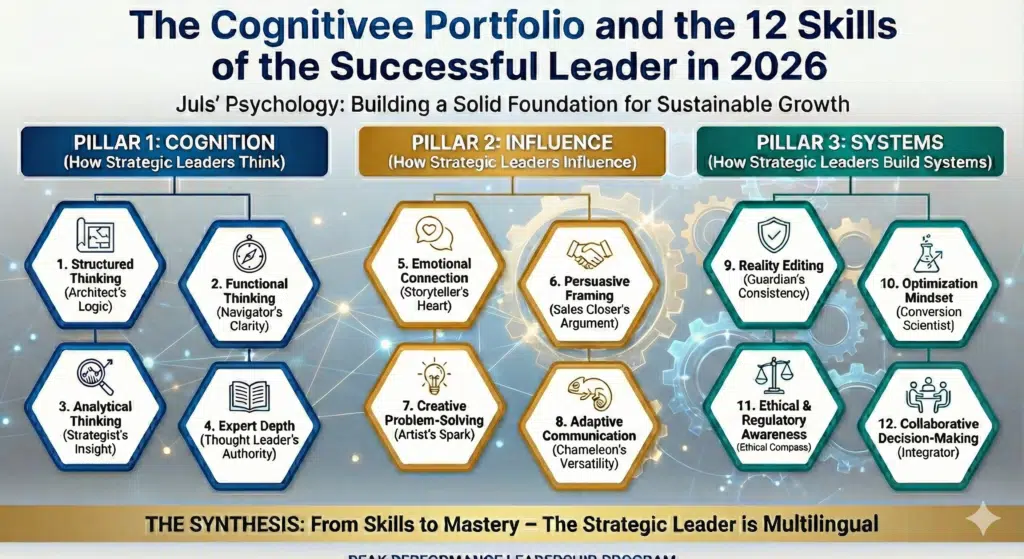
The Cognitive Portfolio and the 12 Skills of the Successful Leader in 2026
At Juls’ Psychology, we take a counter-intuitive approach to this season. For us, Q1 is never about aggressively onboarding new clients. Instead, it is dedicated to restructuring and optimizing our…