
At Juls’ Psychology, we take a counter-intuitive approach to this season. For us, Q1 is never about aggressively onboarding new clients. Instead, it is dedicated to restructuring and optimizing our current portfolio.
Why? Because sustainable growth requires a solid foundation. Leaders cannot navigate the complexity of the upcoming year without a robust framework for decision-making.
What are the crucial thinking skills of the leader of the future? It starts with asking better, more relevant questions. It ends with the ability to switch between being an Architect, a Navigator, and a Storyteller at will.
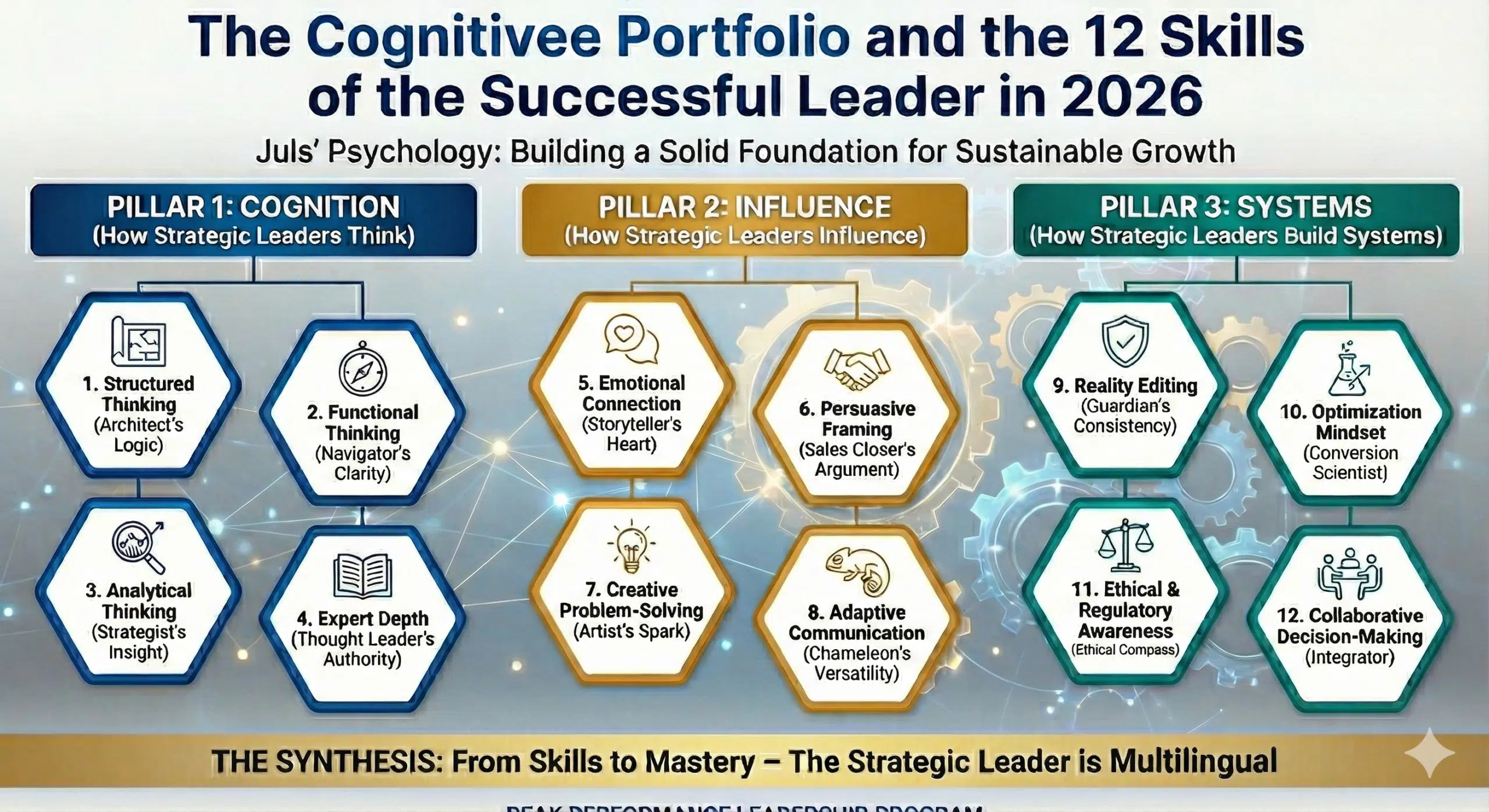
Today, I am sharing the backbone of our “Peak Performance Leadership Program.” This is the core of our 10-12 week individual track, where we don’t just discuss theory—we solve actual business issues by applying 12 distinct lenses of analysis.
Pillar 1 – HOW STRATEGIC LEADERS THINK (Cognition)
1. Structured Thinking – The Architect’s Logic
(From scattered ideas to clear decision architecture, priorities, and steps)
This is the discipline of the Information Architect, the silent force that transforms a chaotic expanse of scattered ideas into a coherent, navigable structure. It begins not with words, but with a blueprint—establishing a logical hierarchy that guides the reader’s mind effortlessly from one concept to the next.
By deliberately crafting descriptive signposts and shaping dense information into digestible, scannable elements, the Architect reduces cognitive load and ensures that comprehension is immediate. It is the rigorous art of turning raw noise into a clear decision architecture, where every transition is seamless, every priority is visible, and the path from confusion to understanding is undeniable.
2. Functional Thinking – The Navigator’s Clarity
(Turning strategy into “who does what, when, and why” so nobody is guessing)
This is the mindset of the Navigator, the disciplined pragmatist who translates high-level ambition into friction-free execution. While others speak in broad strokes, the Navigator operates with the precision of a UX specialist, ruthlessly eliminating ambiguity to ensure that every directive is understood instantly.
It is the refusal to let strategy remain abstract, demanding instead that every vision be anchored in specific, actionable reality. By clarifying the “who, what, and when” with absolute economy of language, this thinking style removes the cognitive drag of uncertainty, allowing teams to move with speed and confidence rather than hesitation.
3. Analytical Thinking – The Strategist’s Insight
(Decisions based on data, behavior and constraints, not mood or trend)
Here lies the discipline of the Strategist, who rejects intuition when it is unsupported by evidence. This involves a rigorous interrogation of reality, treating market signals and behavioral data as the only true north, independent of internal mood or fleeting trends. Just as a content strategist mines search data to uncover hidden audience needs, this leader looks past the surface noise to find the gaps in the market and the silent friction points in the business model.
It is a commitment to objective truth, ensuring that every decision is not a gamble based on ego, but a calculated move informed by a deep, research-backed understanding of the playing field.
4. Expert Depth – The Thought Leader’s Authority
(At least 1–2 domains where they think in depth, not just surface‑level)
This is the domain of the Thought Leader, who commands authority not through title, but through an undeniable depth of understanding. It requires the intellectual stamina to go beyond surface-level fluency and master the intricate mechanics of specific domains. This leader functions as a translator of complexity, synthesizing dense technical realities or academic concepts into clear, compelling insights that define the industry standard.
By committing to deep research and critical synthesis, they become the signal amidst the noise, offering not just opinions, but substantial, foundational knowledge that builds trust and cements their position as a definitive voice in the room.
Pillar 2 – HOW STRATEGIC LEADERS INFLUENCE (Influence)
5. Emotional Connection – The Storyteller’s Heart Translating hard decisions into human meaning and shared purpose.
This is the realm of the Brand Storyteller, the psychological anchor who understands that while logic justifies, it is emotion that drives action. It is the ability to transcend cold metrics and weave the “why” into a narrative that resonates on a visceral, human level. By infusing hard business decisions with empathy and shared values, this leader transforms passive listeners into engaged believers.
It is not merely about reciting facts, but about crafting a vision that builds trust and psychological safety, ensuring that the audience feels the heartbeat behind the strategy, making the mission personal and the connection authentic.
6. Persuasive Framing – The Sales Closer’s Argument Explaining trade‑offs, risks and benefits so that people can commit, not just comply.
This represents the calculated precision of the Closer, the master of rhetoric who builds arguments so robust they dismantle hesitation before it arises. It goes beyond simple exposition to a strategic structuring of trade-offs, where risks are acknowledged and benefits are amplified, moving the audience from skepticism to conviction.
Like a seasoned sales copywriter, this leader anticipates doubts and neutralizes objections in advance, presenting not just a directive, but a compelling case. It is the art of framing the future so clearly that commitment becomes the only logical conclusion, driving stakeholders to buy in rather than merely comply.
7. Creative Problem‑Solving – The Artist’s Spark
(Seeing third options, designing new paths instead of choosing only yes/no)
This is the spark of the Visionary Artist, the force that breaks through the inertia of binary choices to design entirely new possibilities. When logic hits a dead end, this mindset ignites, using associative thinking and original concepts to bypass the standard “yes or no” and invent a “third option.”
It is the refusal to accept the status quo, employing metaphors and fresh perspectives to disrupt stagnant thinking and cut through the corporate noise. By treating business problems as a canvas for innovation, this leader captures attention and redefines the boundaries of what is possible, turning constraints into launchpads for unique solutions.
8. Adaptive Communication – The Chameleon’s Versatility
(Same decision, different language for board, team, customers – without losing the core)
This is the agility of the Chameleon, the master of context who intuitively understands that the message must shape-shift to survive in different environments. It involves a fluid calibration of tone and format, ensuring that the core truth remains unshaken even as the delivery adapts—whether for the high-level gravity of the boardroom or the rapid-fire engagement of a customer channel.
This leader does not simply repeat the same script; they translate the essence of the decision into the native language of the listener. It is a strategic flexibility that maximizes impact across every touchpoint, ensuring alignment without sacrificing authenticity.
Pillar 3 – HOW STRATEGIC LEADERS BUILD SYSTEMS (Systems)
9. Reality Editing – The Guardian’s Consistency
(Protecting standards, values and focus when chaos, trends and pressure hit)
This is the vigil of the Guardian, the unyielding protector of the organization’s core identity against the entropy of growth and external pressure. It acts as the ultimate filter, defining and enforcing the standards that ensure consistency across every interaction, regardless of who is speaking or how loud the market noise becomes.
Just as a ruthless editor cuts through fluff to preserve the integrity of a text, this leader edits the organization’s reality, rejecting convenient shortcuts or fleeting trends that threaten long-term brand equity. It is a systemic commitment to quality and coherence, ensuring that values are not just stated, but operationally maintained even when chaos strikes.
10. Optimization Mindset – The Conversion Scientist
(Treating decisions as hypotheses: test, learn, refine, instead of drama and ego)
This defines the methodology of the Conversion Scientist, who views every strategic decision not as a final judgment, but as a hypothesis waiting to be validated. It replaces ego-driven mandates with an iterative cycle of testing, learning, and refining, grounded in cold, hard performance data.
Like analyzing heatmaps to uncover user blindness, this leader looks for the silent failures in a process, ruthlessly optimizing what exists rather than constantly chasing the new. It is the discipline of continuous improvement, where success is measured by conversion and impact, and where failure is simply data used to sharpen the next iteration.
11. Ethical & Regulatory Awareness – The Ethical Compass
(Seeing second‑order risks for people, brand and institutions before they explode)
This is the foresight of the Ethical Compass, the necessary counterbalance to commercial ambition that anticipates the second-order consequences of every move. It goes beyond mere compliance, functioning as a proactive radar for reputational and human risk before it manifests as a crisis.
By deeply understanding the regulatory landscape and the unspoken social contract with stakeholders, this leader ensures that growth never comes at the cost of trust. It is the wisdom to recognize that clarity and responsibility are not bureaucratic hurdles, but the foundational armor that protects the brand’s longevity and the institution’s integrity.
12. Collaborative Decision‑Making – The Integrator
(Deciding with Product, Finance, People, not in solo‑hero mode)
This is the role of the Integrator, the connective tissue that binds disparate functions—Product, Finance, and People—into a unified operational force. It rejects the myth of the solo hero, recognizing that true strategic impact requires the seamless synthesis of diverse expertise, just as great copy must merge perfectly with design and code to function.
This leader navigates the friction between departments with empathy and negotiation, translating specialized requirements into a shared language. It is the ability to build systems where collective intelligence creates a complete, functional whole, rather than a fragmented collection of isolated wins.
The Synthesis: From Skills to Mastery
Looking at this list, the challenge isn’t just understanding these 12 distinct competencies—it is knowing when to deploy them.
The average leader is stuck in one mode. The strategic leader is multilingual. They know when to put on the Architect’s hard hat to structure a chaotic process, and when to switch to the Storyteller’s warmth to rally a tired team. They know when to be the ruthless Editor of reality and when to be the open-minded Artist seeing a third path. This fluency doesn’t happen by accident.
In the Peak Performance Leadership Program, we don’t just study these archetypes academically. Over the course of 10 to 12 weeks, we use your actual business challenges as the training ground. We take the decisions keeping you awake at night and apply these 12 lenses until the right path isn’t just a guess—it’s a certainty. We don’t just solve the problem; we upgrade the mind that solves it.
If you feel the weight of Q1 and know that your current toolkit isn’t enough for the complexity ahead, it might be time to restructure your approach.
We are currently prioritizing the optimization of our existing portfolio, but we always make space for the right conversation. Let’s make 2026 the year you stop guessing and start navigating.
My story ends here. But yours only begins
You already know what must be done.
Now, for you, it’s time to close this story and to start writing your own.
And for me, it’s time to stay silent and to wait and listen to the stories of humans who are not afraid to reinvent themselves over and over again.
The Path Forward
We can’t change the times. And my job is not to talk about whether you should or shouldn’t make a life or business choice. My job is to educate and empower people on how to use the modern tools, ways, and ideas for proper self-leadership and development without harming themselves or others.
I will show you how the modern trends continue to develop in personal, organizational, business, and market settings by following the simple rule:
The most important resource for your success is YOU!
Be an ocean in a drop.
Change. Adapt. Evolve.
FREE OF CHARGE RESOURCE:
Take Our Psychological Test for Burnout Prevention

Burn With a Bright Flame, Not Out!
Our free psychological test is design to help you assess your resilience, effectiveness under pressure, and ability to stay calm and productive. Answer each question with a quick ‘Yes’ or ‘No’—there’s no right or wrong response, just insight into your unique experience. If your inner strength feels low, consider seeking support.

Our Newsletter:
Enhance Your Business Systems
Get free training, CEO interviews, and insights—stay connected while you await a spot on our waiting list. We optimize processes, operations, and tech solutions, connecting you with the right people.
Confidentiality is our priority. Strict NDAs protect our clients’ unique strategies, while valuable insights and knowledge are shared in case studies delivered straight to your inbox.
Let’s transform your ideas from the inside out.
FAQ SECTION:
Our customers’ TOP 10 questions

OUR TEAM:
Who are We
THEY BELIEVED IN US
The Library of Shared Stories


So talented and dedicated!
I wish everyone the pleasure of working with Juls.

During our meetings she helped me to clarify my overall concept, to structure my business strategy, to gain confidence and to see the sense of what I do in a new way. She inspires me.
Thank you, Julika, for the valuable advice and warm support!

Thanks to people like you, I believe in the goodness and purpose of myself! I hope I will soon be resourceful enough to be useful and helpful like you! Thank you for your understanding and patience!
See you soon!

I am blessed to have found you and grateful to have you! I can already say from experience that with your help, people who trust you run their marathon of personal and professional growth more easily and confidently!
I am very grateful for your patience with me!

I came with the following expectations: personal support,
guidance on what to work on.
I left with the satisfaction of your ideas, the path laid out, the tasks on a personal level. I feel more energized, with more
inspiration, with more self-confidence. Greetings! Beautiful day!



OUR CUSTOMERS:
Client Success Stories

We are proud of our 15-year track record of success. While we don’t achieve every goal, we’re relentless in pursuing excellence.

We are the innovators you need to turn your business idea into a market disruptor. Make your ideas stand out.

Confidentiality is key to our success. We work under strict NDAs to protect the data and competitive advantages of our clients.
OUR PUBLIC RELATIONS:
Featured In & Our Official Partners
READ MORE PROFESSIONAL ARTICLES:
Grow Your Ideas with Juls’ Psychology
Why Do Most Startups and Scaleups Really Fail?
Why Do Most Startups and Scaleups Really Fail? Look at any startup post-mortem and you’ll hear the same words: cash flow, timing, product-market fit. Rarely does anyone name the real…

When Do You Stop Believing in Yourself and Your Business? [My 3 Bold Steps]
When Do You Stop Believing in Yourself and Your Business? [My 3 Bold Steps] When do you stop believing in yourself and your business? Today I will share my experience…
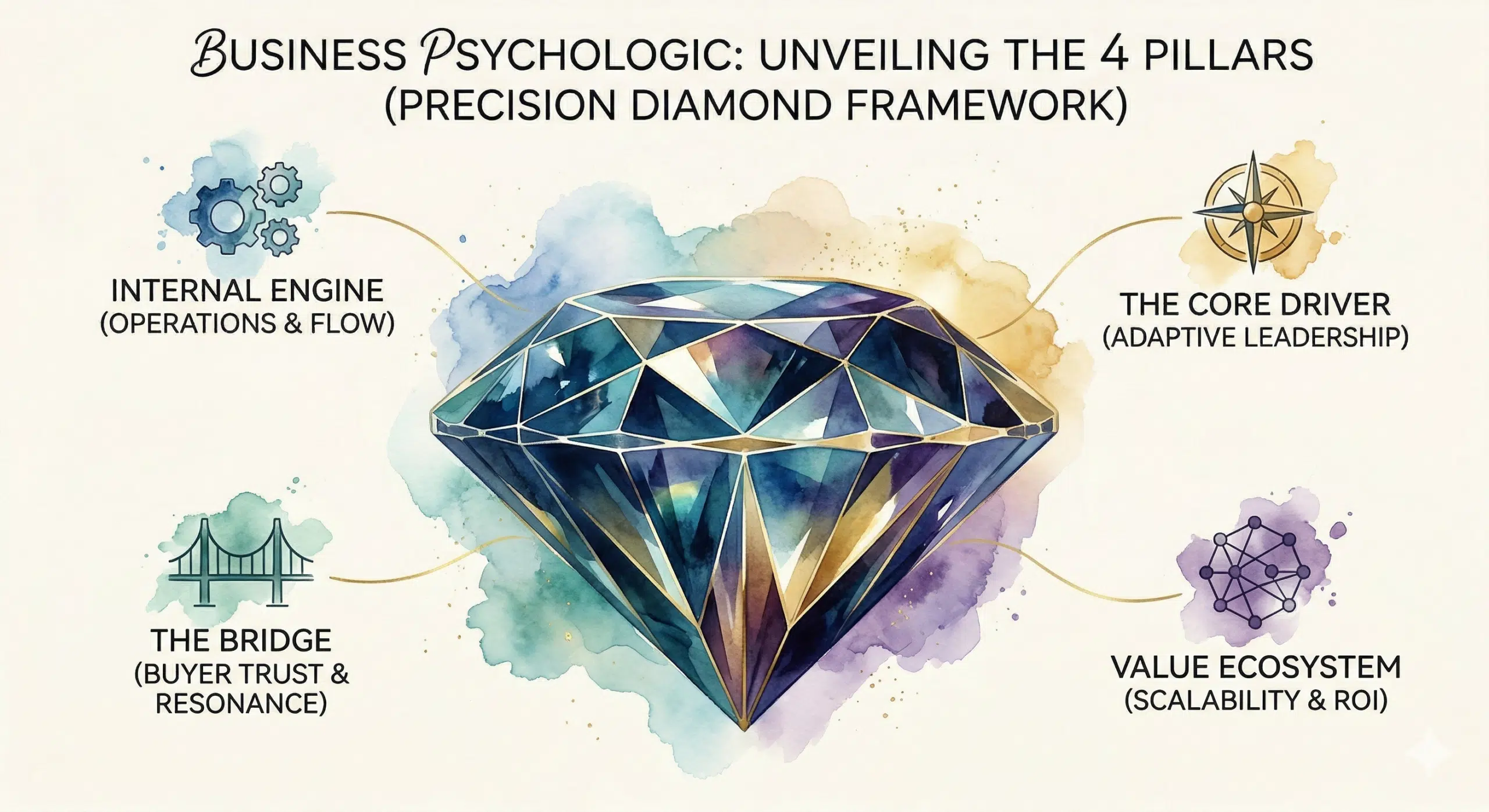
How to close the gap between your vision and the actual execution?
Most businesses do not fail because the strategy is wrong. They fail because the promise, the delivery, the leadership behavior, and the AI workflows do not line up. Business PsychoLogic…