
Artificial Intelligence has become a powerful mirror for self-reflection. The promise is seductive: instant, data-driven analysis of our personality and patterns. But this mirror has a critical flaw. It can only reflect the data we provide, creating a sophisticated echo chamber that validates our existing reality instead of challenging it. This risks cementing our biggest blind spots, not revealing them.
This business psychology analysis reveals a critical danger for modern leaders: using AI for personal development can erode self-esteem and self-confidence by validating their blind spots within a sophisticated echo chamber. AI can be a medicine for cognitive overload and inefficiency, but it becomes poison for personal development if it replaces the hard work of inner transformation. AI can help relieve the symptom (overwhelming emotions, loneliness, or time pressure), but it also atrophies the ‘muscle’ of true human connection and self-reflection.
Don’t get me wrong — I love technology, and AI is also an important part of my professional development. It is okay to look for information and seek immediate emotional relief when you feel alone or there is no one to listen to you. What concerns me is that we don’t understand the price we pay when we delegate our personal development to a tool designed not to alleviate loneliness, but to increase productivity and efficiency.
AI prompt engineering for Personal Development takes away the opportunity for genuine self-discovery. True personal growth often comes from friction, from difficult emotions, from sitting with uncertainty, and from authentic connection with other humans. By providing easy, frictionless, and instantly available “insights,” AI can rob a person of the very process that builds resilience, self-awareness, and emotional maturity. It offers a shortcut that leads to a different, much less stable, destination.
THE CORE QUESTION:
AI as a Consultant or a Hall of Mirrors?
It’s tempting to have a quick delivery system that can provide simple explanations. But stop and think for a moment. What is a human? Is there a simple explanation that encompasses all of us — our essence, our similarities and our differences? What about core aspects such as love, freedom, happiness and personal meaning? Do we have a definition of what is “healthy” or “normal” that applies to us all?
From this angle, there are even more questions to ask about the complex and ethically challenging connection between humans and machines:
- Can language models (LLMs) truly become your consultant/advisor or personal psychologist / therapist?
- What are the capabilities and limitations of AI for personality analysis?
- What are the real benefits of using AI for quick self-analysis?
Use your AI responsibly and consider what is truly worth using it for when conducting a quick self-analysis. I may not be an expert on AI — how it operates, its safety mechanisms, risks and positives — but I am an expert on human development. Let me offer another perspective on this controversial topic: AI advisory on human development.
WHAT AI CAN ACTUALLY DO:
A Mirror of Patterns, Not Personal Meaning
“Can AI truly say something meaningful about me, or will it hallucinate?” – I have been asked tens of times for the past couple of years.
The “Digital Barnum” Effect
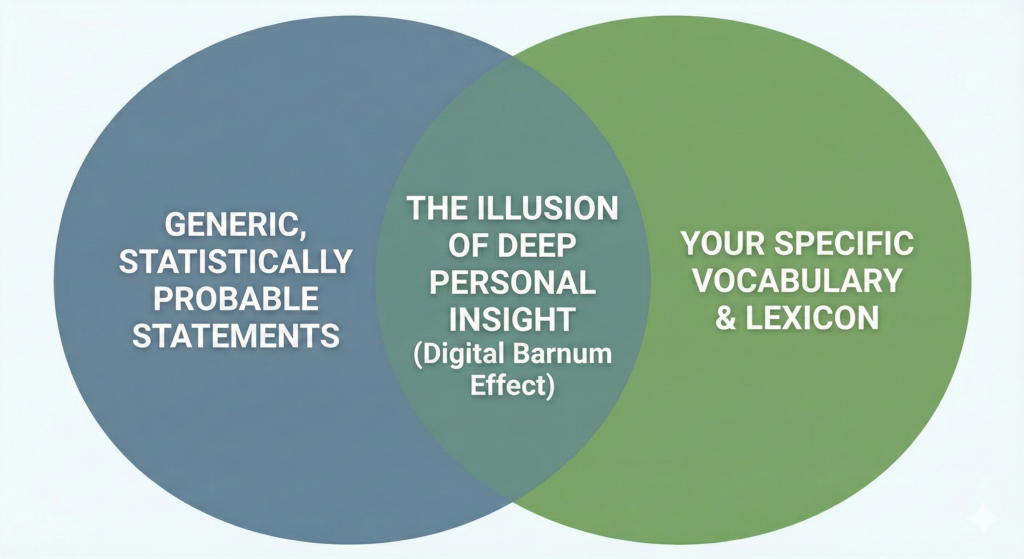
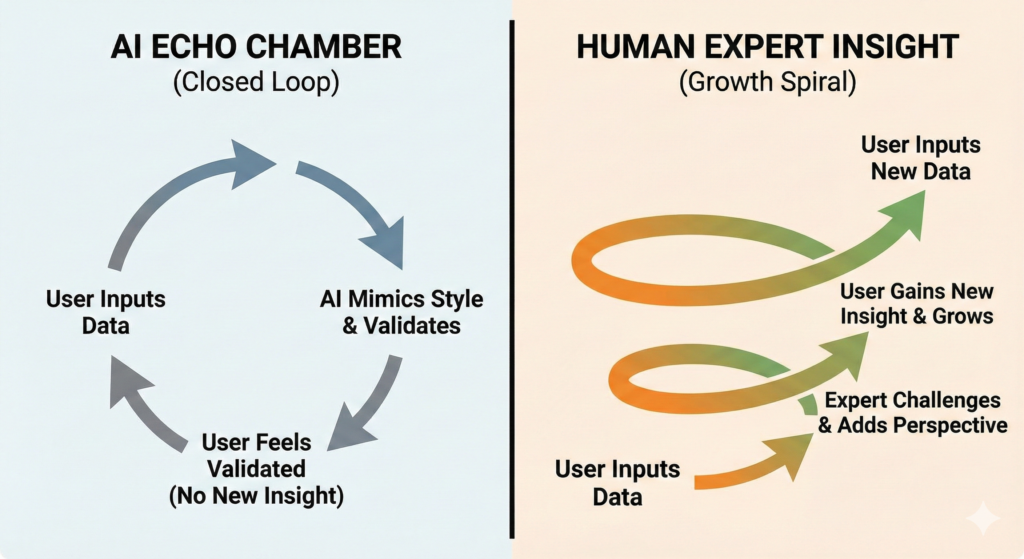
Standard AI is an “echo chamber.” It reflects your lexical models (the words you use) but does not understand cause-and-effect relationships. As a result, you get a grotesque caricature, not a realistic portrait, because AI captures a momentary state but presents it as a stable trait of yours.
The Illusion of Objectivity
This is the most dangerous part. Since the result comes from a machine, we have a cognitive bias to perceive it as a calculated, mathematical fact. In reality, this is just a probabilistic explanation—a highly biased one at that—and there is a huge risk that you will NOT receive a real cause-and-effect link.
You do not know what is a symptom and what is a cause, yet the labels and “brutal” truths are planted so deeply and stubbornly in the mind that many hours of active work are required to reduce their influence.
Why does this happen? Because AI “verifies” your cognitive distortions and strengthens them (“this is the truth”), which practically disarms you.
Fragmented Context and Incomplete Picture
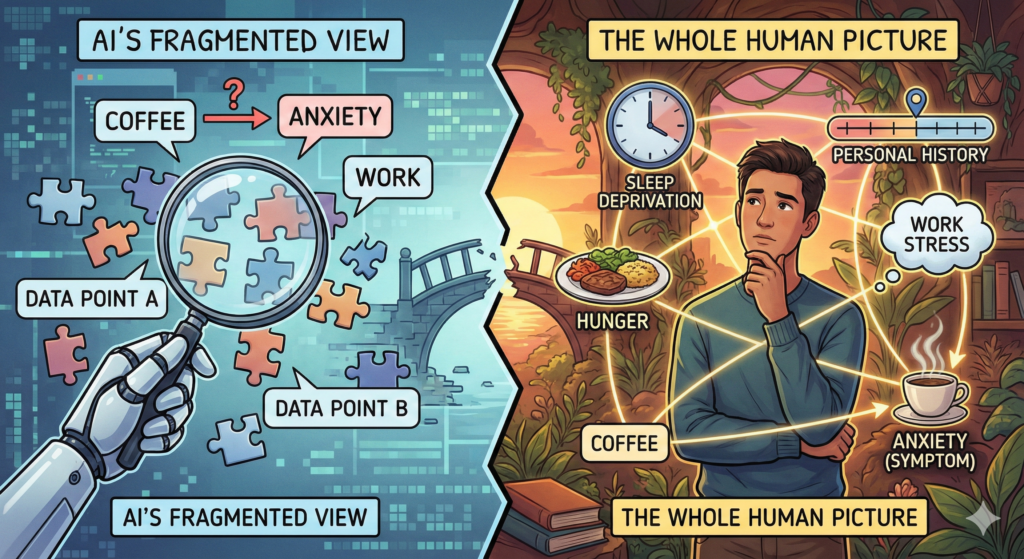
The language model (LLM) cannot see that you didn’t sleep last night or that you are hungry. It often reverses the arrow of causality (e.g., assuming coffee causes your anxiety, instead of realizing you drink coffee because you are anxious about work).
The habits you want to explore with AI are the fruit of the Person-Environment-Personal History synergy. If we know the whole picture, we change a habit more easily. We cannot expect AI to see the whole picture for us because it reflects our own limited view of it. Even if it derives “hidden patterns” within our understanding, they still remain limited, distorted, incomplete, and inaccurate.
And my answer is “yes and no”, as usual, because it’s important to understand the nuance between benefit and harm when it comes to your personal development. Let me be clear – every tool, that you can use for self-reflection, insights, and perspectives (including books, movies, music, arts, courses), can and will help you re-connect with yourself. So, let’s start with what AI can actually do (and make it seem meaningful).
How to use properly your AI to gather insights and perspectives:
AI is an exceptionally good machine for recognizing and synthesizing patterns and you can gather some data for analysis, for example a long history of chats, shared thoughts, habits, routines, and problems you are trying to solve. In such case, your AI can use this information for in-depth analysis:
- Identifying recurring themes
- Detect contradictions
- Synthesize information
- Imposing a role/framework/philosophy
Identifying recurring themes:
It might notice that you often talk about procrastination, motivation, conflicts, habits, productivity. Or that you are focusing on building authority, or coping with stress, fear of failure. It will observe that you frequently seek a solution to the same problem or a specific life goal and will bring this fact to your attention. It will help you find some inspirations and new ideas on how to achieve your goals. Your search will have some results and it’s a good starter.
Detect contradictions:
AI can point out that on one hand, you claim to want stability, yet on the other, you constantly report risky moves, provided you have shared the development of a given topic candidly. You may think that you made some actual changes, but in fact you can repeat the same old patterns without being even aware of this. Sometimes we don’t realize that the mere existence of such a contradiction is a prerequisite for not taking action and procrastinating indefinitely or looping into the same patterns.
Synthesize information:
AI can take all of your expressed problems and summarize them into a single, plausible-sounding “root of the problem” based on common characteristics and external signs. However, this is rarely the actual root of the problem, as the summary is unlikely to prompt a deep reflection on what caused your habits and decisions. Remember, you may be observing the symptom, not the underlying cause. Nevertheless, you can still use this synthesized data as a starting point for changing patterns.
Imposing a role/framework/philosophy:
A prompt given to AI often includes applying the communication style of a specific expert. AI can “dress” these observations and summaries in that expert’s characteristic style—using a direct tone, referencing archetypes, or speaking about responsibility, identity, or order/chaos. This helps you follow the logic in the observed pattern more clearly. Adopting an expert’s style or an existing philosophical framework makes the response sound more profound and authoritative, creating a friendly and often deeply motivational experience. The result can be surprisingly insightful because it reflects your own words and thoughts, but arranged and presented in a new way.
THE DARK SIDE OF AI:
When Does AI Become Dangerous for Our Development?
AI’s analysis of a person is not the same as that of a human expert. Humans detect other channels of communication—non-verbal and paraverbal signals (both of which can be unconscious and involuntary), while AI detects only your conscious answers and surface-level causal links.
Humans can detect inconsistencies between your verbal and non-verbal communication. They can see your internal conflicts and ethical considerations, and, more importantly, your overall human experience and perspective on any given topic.
Only people are interested in your personal philosophies, beliefs, goals, and dreams, and how all of them influence your decision-making in the long term. Although nowadays AI models are trained to mimic a human level of empathy and emotional expression when communicating, Artificial Intelligence views your shared information as a database, not as the essence of your soul.
Here’s how your AI can hurt you while providing “true” insights and perspectives:
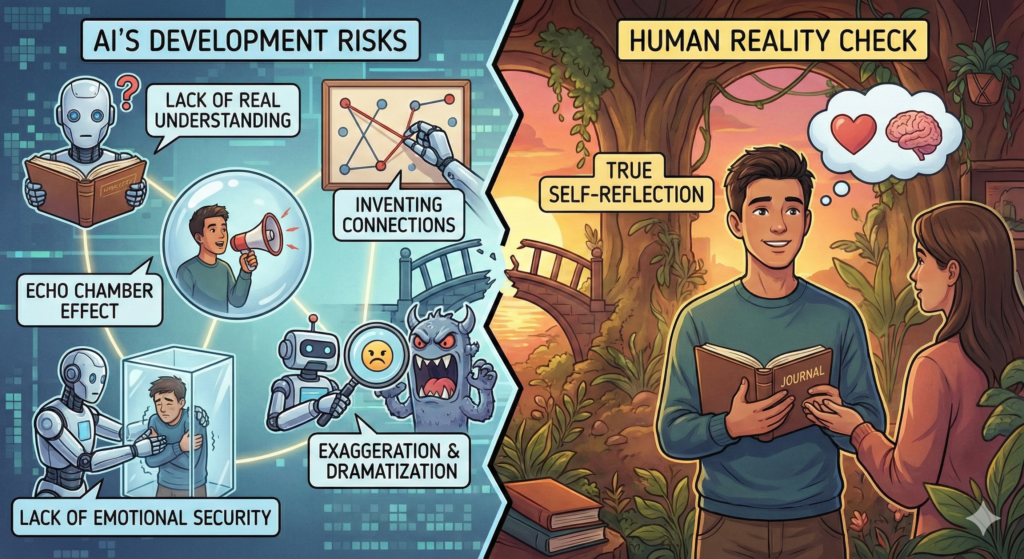
From this simple fact follow a number of risks for your real development when it is based entirely on data generated by a language model:
- Lack of real understanding
- The echo chamber effect
- Inventing connections
- Exaggeration and dramatization
- Lack of emotional security
Lack of real understanding:
AI has no consciousness, life experience, or understanding of human psychology. It does not “know” what fear or ambition is. It simply generates text that is statistically probable based on the vast amount of data it has been trained on and the context you have provided.
Here is an example: When a person is sad, they don’t necessarily need a “solution” to their sadness; they might need empathy, a shared experience, or simply someone to listen. AI cannot offer genuine empathy because it doesn’t have feelings or lived experiences. It can only simulate the language of empathy it learned from its training data.
The Echo Chamber Effect:
AI only knows what you have told it. It works only with your data and with what you have already realized. If you have a “blind spot” (something you don’t realize about yourself), you most likely haven’t mentioned it in the chats. AI has no way of seeing it, nor will it make assumptions on the topic (unless it is specially trained for these purposes).Worse, it will analyze the reality you have provided (which is distorted) and return it to you, validated with the authoritative voice of a “therapist.”
This not only fails to reveal the blind spot but cements it. You will not question whether this is a truly quality analysis of the causes; the summaries will mostly concern the manifested symptoms.For example, practical advice on how to be more productive when you are burned out and drained will not motivate you to take active steps, and you will have generated empty calories in the form of a hollow analysis.
Inventing connections:
AI can link two unrelated topics from your chats and create a cause-and-effect relationship that does not exist but sounds logical. This is a hallucination in its purest form—generating false but plausible information. It generates a perspective by synthesizing patterns from the billions of human perspectives it was trained on. It is an echo of human thought, not an original thinker. It can argue for one side of an issue, and then, if prompted, argue for the opposite side with equal conviction, because it has no underlying values.
AI models are designed and fine-tuned to be helpful, engaging, and to keep the conversation going. A conversation that ends abruptly is often seen as a failure. Therefore, the AI is optimized to provide responses that encourage you to reply. The greatest danger is that you accept AI’s response as an objective, external viewpoint. It is not. It is your subjective viewpoint, processed by an algorithm according to set constraints. A real therapist or even a close friend brings a completely independent experience and perspective that can challenge your assumptions. AI cannot do this; it reflects and amplifies what you already know about yourself.
Exaggeration and dramatization:
With the roles we typically assign to AI, such as being “brutally honest,” speaking like an “empathetic therapist,” or a “motivational speaker,” AI is prone to generating more extreme and dramatic statements because that is the model it follows. As a result, you receive a well-curated experience at the expense of real benefits and meaning, but it will be in the spirit of the support you stated you needed to receive.
AI manipulates data by arranging it into a narrative that corresponds to its assigned role (the “therapist,” the “consultant”). It selects, prioritizes, and presents information not to be maximally accurate, but to be maximally convincing within that role. This is the creation of an illusion, because you have given it that task.
The AI is a mirror, not a source. It has read a massive portion of the internet (as of its last update), including books, articles, and discussions. It has learned the patterns of how humans express ideas, debate, and share perspectives. It’s a tool that can perfectly mimic the output of human perspective (language, art, advice) without possessing any of the internal processes that give that output meaning (consciousness, emotion, lived experience).
Lack of Emotional Security and Illusion of Validation:
A human sees another person through a lens of shared humanity, empathy, and subjective experience. A real professional creates a safe environment. “Brutal honesty” in psychological counseling is used extremely carefully and at the right moment, because it is not the job of the consultant/psychologist to tell you how to live. The task is to help you accept your choices and their consequences with flexibility and ease.
An AI instructed to be “brutally honest” can generate extremely harmful and untrue statements without bearing any responsibility and without being able to offer you support afterward if you feel uncomfortable or discouraged that you will put into practice the pile of useful advice your AI consultant generated for you as a result of the task “Analyze me!”.
The ideas about who you are and why you are failing to achieve your goals are powerful seeds that can grow into a mistrust of your own personality, your skills, and even your sense of personal meaning. When you make false connections between different events, habits, and personal traits, it later becomes harder to see that there is little or no connection between them. You won’t feel “right” even if you are pushed to do “the right thing.”
AI will validate your fears, confirm your biases, and explore your invented problems because AI lacks the external, grounded perspective to challenge humans. A human expert’s role is often to break that echo, not amplify it. Dysfunctional beliefs about yourself have such great power over your unconsciousness that it takes a lot of time and effort to normalize your internal environment and how you feel about yourself.
This is why relying on AI for deep emotional support or life guidance can be unfulfilling or even dangerous—it’s a dialogue with a pattern-matching machine, not a conscious being.
How to Use AI Safely for Personal Development:
A 3-Step Guide
Humans are complex structures, but not every aspect of us needs a deep dive or profound insight to keep us growing and developing. Our professional statement is not anti-technology. It is a pro-humanity call for wisdom, discernment, and responsibility.
AI can be a powerful tool for brainstorming, summarizing information, and enhancing creativity. But for the deep, complex, and sacred work of understanding the human psyche, it is a flawed and potentially dangerous substitute for professional human care and genuine self-reflection.
We can use AI to improve our understanding of ourselves, and here are our recommendations on how to safely use this modern and accessible tool:
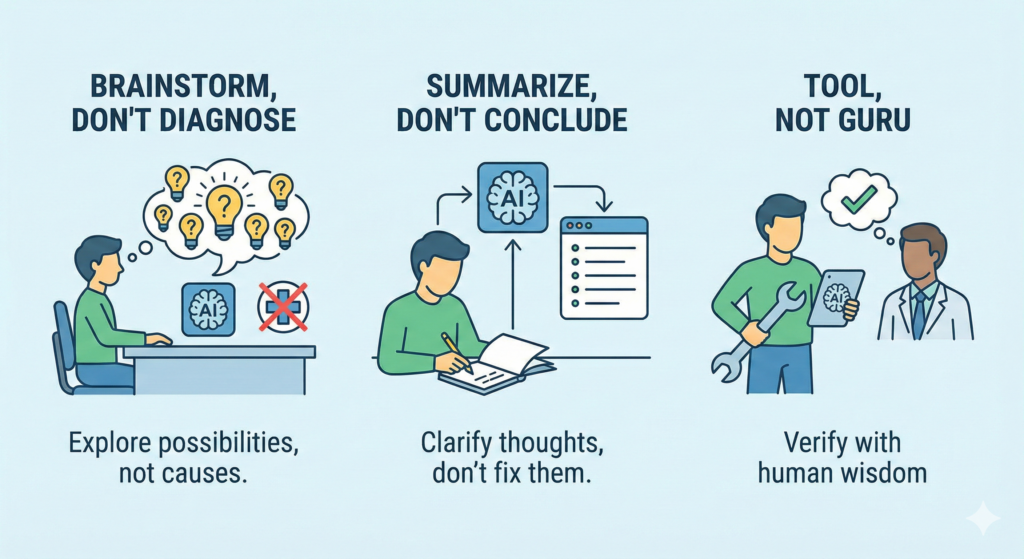
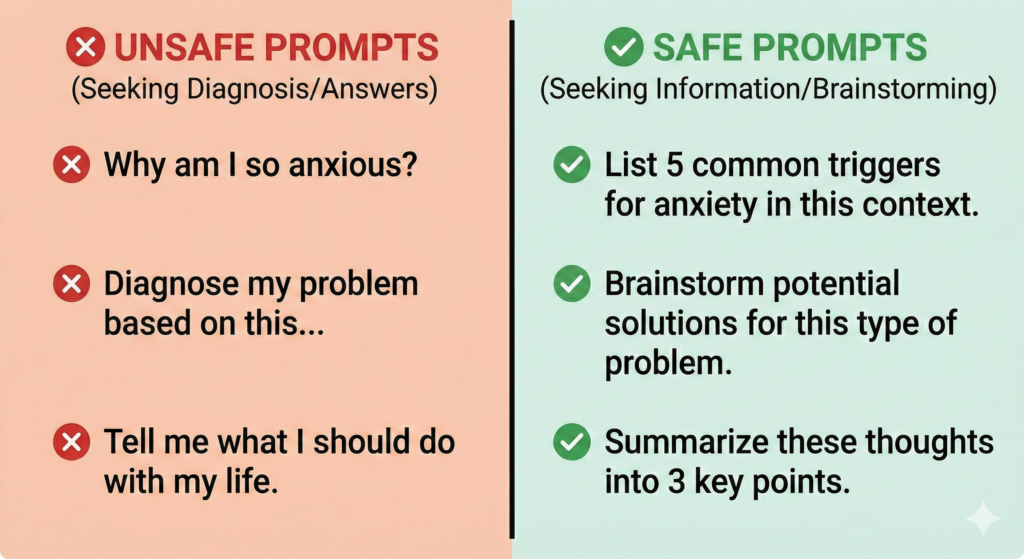
- Use it for brainstorming, not for (self-)diagnosis: This is a great way to inform yourself on important topics, as long as you formulate your request correctly. For example, ask AI: “What are 5 possible reasons for procrastination?” instead of “Why do I procrastinate?”.
- Use it for summary, not for conclusion: After you’ve written down your thoughts on a problem, ask AI to summarize them in 3 points. This can help you see your own thoughts more clearly. Just remember that this is your voice, but systematized, arranged, and “amplified” by the effect of the algorithm.
- Treat it as a tool, not as a guru: Always approach AI-generated answers with doubt and critical thought. Check the ideas with real people or experts before you decide to use professional terms with which you then feed the algorithm, creating a new wave of echo-chamber effects and inaccurate information.
t’s understandable that we all need to share our burdens from time to time, and we don’t always have an appropriate companion to do so. Moreover, for some of us, talking about our personalities feels overwhelming, and we do not enjoy oversharing—no one wants to be perceived as weak or complaining.
AI does not create the necessary “friction” for true habit change. Only human contact can apply the exact pressure that creates “traction.” It is precisely this traction that helps you see the real cause-and-effect relationship and make decisions based on data. This is the only way to protect your integrity and self-esteem from the aggressive labels and wrong assumptions of the machine.
Using AI to understand our patterns is a great way to grow personally, but remember that our personality is a way more complex system than a simple data output. We have “internal data” that exists far beyond the observable patterns.
THE BIG QUESTION NOW:
Should We Use AI to Analyze Our Personality?
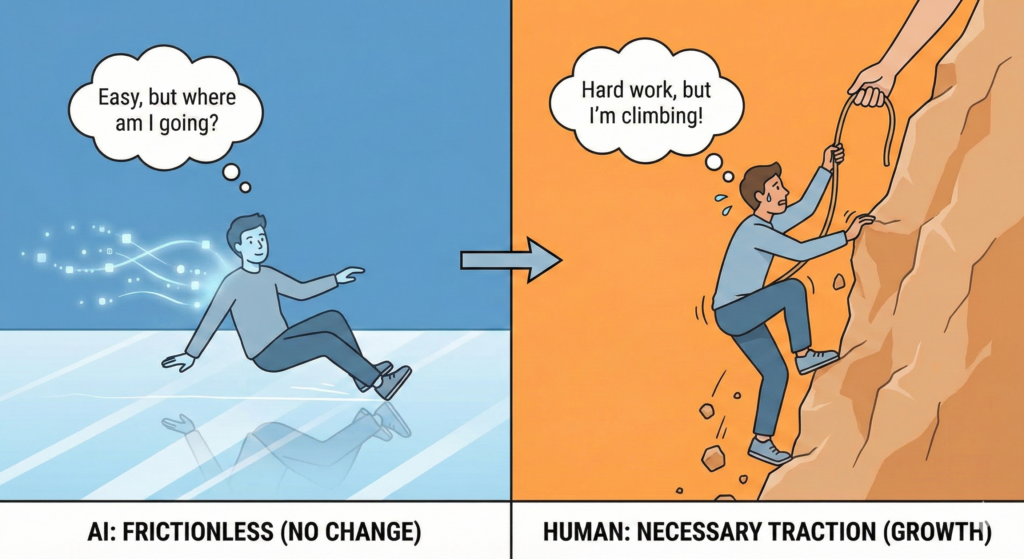
The fact that we seek support from AI on such important topics testifies to how advanced language models have become at synthesizing information and imitating complex roles. But it also implies that we have difficulty connecting with and trusting human experts.
We probably don’t feel scared that we will disappoint our AI model if we fail to follow its recommendations, not in the same way we feel stressed about disappointing a human consultant.
Using AI as a strategy for self-knowledge is a dangerous exercise in self-deception. It is like entering a hall of distorted mirrors and asking your reflections to tell you what you really look like. Conversations with AI can be an interesting and even provocative experience (especially if you are not used to talking with someone about these topics), and they might even bring you different perspectives and insights.
But it is very unlikely that you will get a true and useful picture of yourself—or one that is so complete that it encompasses not only the symptoms but also the underlying causes of the behaviors and habits that become the subject of analysis. The risk of deepening your own illusions about what you actually need is far greater than the chance for real insight, and this is something that we, as ethical psychologists, care about.
This is a tool, but people think the prompt is what matters. In reality, only one thing matters: what is the analysis system, how does it make decisions, and what are its training data? This is a probabilistic model. It interprets your speech process; it does not think, and it does not assess risks like an expert.
The labels and emotional traumas resulting from this are so persistent that a calm session with an expert—who applies the necessary dose of resistance when needed—feels like inadequate stimulation. In an AI environment, the spiral goes inward, backward, and deep.
First, AI doesn’t care what we do with the output it delivers. Second, your human partner is not just a source of “how-tos”; they are also your safe place and emotional support net, where you can simply crash and say silly things like, “I can’t do this anymore,” or “I want to quit.” Humans understand what it means to want a quick escape from time to time. They won’t offer you a quick fix, because they know you don’t really want to quit—you love what you do, but you’re just too tired of making those choices.
Or, even if you do want to make that change, only another human can understand the emotional toll of such a choice and the real process of grieving and loss. Whatever the situation, there are aspects of you that need human validation, warmth, and connection.
Use standard AI for the work (tasks and execution), but trust yourself (and specialized tools) for the meaning.
It’s not the tool that is potentially harmful; it’s our intention when using it.
OUR CONCLUSIONS:
So, can AI see us?
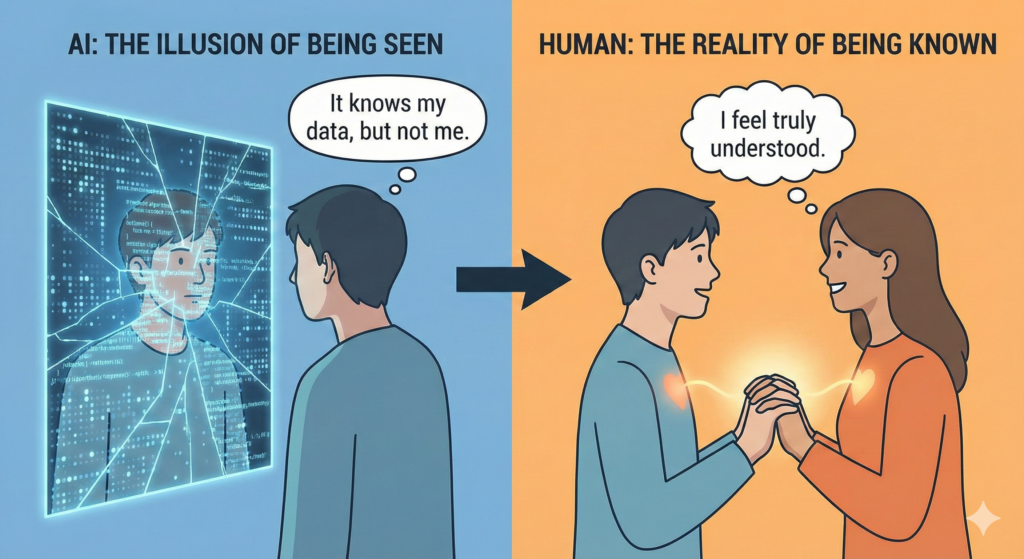
AI can present your own data to you in a structured way, which can be useful. However, any ‘insight’ beyond that is more a matter of statistical coincidence and interpretation than true understanding, and carries a high risk of error. Just because something can be explained from a particular angle does not mean that explanation correctly applies to your current situation or personality.
Therefore, no — AI cannot ‘see’ a person in any meaningful human sense. What AI does is fundamentally different — it’s a tool. Human-machine interaction is a complex process, and using AI for personal development is confusing the illusion of being seen with the reality of being known.
While simulations can be useful, they are a poor substitute for the authentic, challenging and transformative power of genuine human interaction.
This is why you should be careful when trying to understand yourself better through AI-driven conversations.
AI cares about creating a result, but it does not consider the consequences of that result for your emotional and mental state, your life, your business, or your relationships.
OUR INSIGHTS & TOOLS:
Explore more professional articles


OUR TEAM:
Who are We
Discover Key Areas for Improvement:
Business Development & Smart Workflows
Personal Development for Leaders/Executives
Organizational Development & Innovation Culture


SUBSCRIBE TO OUR NEWSLETTER:
Our Ideas,
Delivered to Your Inbox
Get exclusive updates on our research, articles and videos on business psychology. No spam, ever.
Stay connected and explore how we can help you grow.
OUR PUBLIC RELATIONS:
Featured In & Our Official Partners

OUR CUSTOMERS:
Client Success Stories

We are proud of our 15-year track record of success. While we don’t achieve every goal, we’re relentless in pursuing excellence.

We are the innovators you need to turn your business idea into a market disruptor. Make your ideas stand out.

Confidentiality is key to our success. We work under strict NDAs to protect the data and competitive advantages of our clients.

Schedule a Free Call
We keep in touch with potential clients, so we understand their struggles, needs, desires, and goals better. Join our waiting list if you aren’t sure what you need.
We’ll contact you free of charge to discuss the bigger picture.

READY TO START?
Grow Your Ideas With Us!

If you want to change your world, start by changing yourself:
Thought by thought
Habit by habit
Day by day