

Why Do Most Startups and Scaleups Really Fail?
Look at any startup post-mortem and you’ll hear the same words: cash flow, timing, product-market fit. Rarely does anyone name the real fracture point, and it’s almost never about the product. It’s about what I call People-Product-Market Fit (PPMF): the measure of whether a real person trusts your product enough to let it into their daily life, not whether it looks good on your roadmap.
As a business psychologist, my job is to understand the human side of the tech business, and PPMF is the lens I use to run analysis, improve operations, and bring clarity at the C-level. PPMF is my way to show founders why they may have a sharp product and people still don’t engage, adopt, or use it as expected. You can build a technically flawless engine. Features that are brilliant on paper. But once that product meets a real person, with real habits and real hesitations, the theory stops mattering.
All we need to understand is the client’s subjective reality and what triggers the reactions we observe. Ultimately, the only KPI that matters is increasing MRR and retention. Answer the questions I prepared for you at the end of this article honestly, and you’ll find out why users actually hesitate, not why you assumed they would. I recommend sending these questions to your existing users, and being ready to hear what they actually think and feel, in order to understand their behavior better.

What is People-Product-Market Fit, and why can’t you miss this angle in Go-to-Market (GTM)?
People-Product-Market Fit is a systemic analysis I run to help founders understand the complexity of human behavior in business settings, to avoid oversimplification and underestimation of key factors that influence buyer perception and user adoption.
My focus is on exploring how the product builds a system with the client, and how the specifics of this system influence how people think, feel, and react to the brand’s behavior: marketing, sales, onboarding, usage, long-term relationships. This is an interdisciplinary approach where the cross-functional team (product, marketing, sales, leaders, PM, legal, and finance) must be aligned, because retention is our ultimate goal, and this is definitely a team play.
Looking at your product through a psychology lens means asking difficult questions your roadmap, or your AI, usually skips:
- What does this tool ask someone to give up in their daily routine?
- Where does initial enthusiasm quietly turn into fatigue?
- How does someone’s sense of fairness and trust decide whether they take the risk on you?
When companies plan their Go-to-Market strategy, most of the time they try to predict success by aligning their decisions with industry standards: how many people use similar products, how big is the market, what’s the expected revenue. These numbers are important, they push us to think at scale. But they’re just GPS dots. They don’t automatically translate into a clear trajectory we can follow blindly. Unfortunately, most founders do exactly this: they believe these numbers are their KPI.
What makes the market go quiet?
If people don’t recognize the problem you solve, don’t see your tool as the answer, and feel the price isn’t fair, they walk away in silence. Your code may not have failed. Your PPMF probably did.
Standard business logic doesn’t always match the human perception of what is logical, because we make decisions based on 3 major subconscious factors: is it safe enough, is it low risk, does it make the pain go away immediately.
No hook can outrun ambiguity, lack of trust, low transparency, and unclear terms. And no behavioral analysis can motivate disappointed buyers to become power users, if the tool isn’t an actual tool, if there’s no proper process design, if the workflow is overengineered for its purpose, and if the service isn’t excellent.
How do you define whether you’re building for people, or just to indulge your passion to build?
Business psychology can help you build sustainably by answering four questions before you spend on Go-to-Market expansion.
1. Is the pain real, or assumed?
We love talking about solving pain points. But what actually creates friction? An objective block, or a subjective perception?
When you set out to resolve an objective crisis, you have to calculate the full price the client pays. Not just financial. Legal, social, psychological too.
Can your product resolve the crisis without asking people to pay a cost they can’t stomach?
2. Why aren’t current solutions good enough?
People already have workarounds. What do those workarounds fail to solve, in a way that leaves someone satisfied and at ease?
You rarely need something radically new. Often you need to combine what already exists in a way that makes the journey easier to adopt, and satisfying during long-term usage, without too much cognitive load and emotional overwhelm.
If your product only claims to solve the crisis, without proving it’s clearly better than what people already use, you hit a wall of hesitation. Is this really right for me, right now? Structure, logic, and simplicity beat everything, every single time.
3. What painful reality stays if they don’t choose you?
If you don’t build this, what stays broken inside their workflow or everyday life?
Map that reality precisely, or you’ll never handle the rejections, the skepticism, the objections that show up in pre-sales and pilots. If you can reconstruct your ICP’s day-to-day decision-making, you can understand the subconscious patterns that govern their behavior. We can predict churn long before we see the patterns on our dashboard.
4. Can you actually deliver the promise?
Honesty with yourself is non-negotiable.
Over-promising and under-delivering breaks trust. It breaks your name. That matters most when you’re trying to earn enterprise backing or VC funding.
Does your product add relief, or does it add stress? Too many teams solve one problem and quietly load a heavier one onto the user’s day. And most of the time, they don’t even think about it.
People-Product-Market Fit is the practice of mapping human perception. What your product adds to someone’s day, what it takes away, and how you signal enough safety and fairness for them to take the risk on you.
When companies stall, it’s rarely a technical bottleneck. It’s founder and team ego, and it shows up in three ways.

Is your business loosing people?
Run the People-Product-Market Fit and discover what’s actually costing you retention.

How does human ego kill tech product development?
Denial: Refusing to admit the product has dark sides, missing pieces, or that clients genuinely struggle to see the value. Denial keeps you locked inside your own assumptions. Real market momentum means expanding what you consider “normal” to include how other people see it. See, the market isn’t just numbers. That’s actual people.
Deflection: Rejecting data, pilot feedback, or outside analysis because it’s uncomfortable. A client once told me I was deliberately poking holes in her business just to sell my services. She was defending against the data, not against me. That’s what deflection looks like from the inside, and it’s normal when you feel threatened. We can overcome our fears and still be brilliant decision-makers if we remember that at this stage of development, our feelings are irrelevant. Only client feelings matter, and we have to protect them, not our ego.
Wrong attribution: When interest doesn’t convert, teams blame the ICP, the positioning, the market. Targeting matters. But blaming the market blinds you to what’s actually happening inside the product experience. Both your engaged and disengaged users are giving you real data. Ignore either one, and you stay blind to what’s actually blocking conversion. Your feature development lies on the continuum between “highly relevant” and “highly irrelevant.” Your choices, actions, and communications can move the needle, not the market’s perception per se.

You can’t out-market or out-hire a failure of human alignment
/Ask your users & clients these questions/
If MRR is flat or falling despite new hires, new sales spend, more GTM, the problem was never really the market. It’s the fit between what you built and the people you think you built it for.
You don’t have to guess at the answer. Ask your users directly. Here are ten questions that surface the real data, not the polite version. Take them, adapt them, send them, then listen to the voice of your people:
1. What’s the one feature you’d miss most if we disappeared tomorrow, and why that one, specifically? [Isolates real value from feature-list noise. People rank; they don’t list.]
2. What made you choose us over what you were using before? [The decision moment tells you what actually broke the old habit. Everything after that is retention, not acquisition.]
3. Think of a week you almost stopped using us. What made you stay, or what would have made you leave? [Churn risk lives in near-misses, not in exit surveys. This is where the real friction hides.]
4. If we didn’t exist, what would you actually do instead? Not “nothing.” What’s the real fallback? [Tells you who you’re actually competing against. It’s rarely the company you think.]
5. How urgent is this problem for you right now, this month, not someday? [Urgency is what turns interest into a decision. Without it, you’re selling to people who agree with you but never buy.]
6. Does using us feel like removing a weight, or adding a new one to carry? [Direct read on whether you’re solving the crisis or quietly relocating it.]
7. What’s still missing before this becomes part of your routine, not something you only remember when it breaks? [The gap between “useful” and “habitual” is where most products stall.]
8. If this problem stays unresolved six months from now, what does that actually cost you? [Makes the cost of inaction concrete. If they can’t answer this, the pain wasn’t real to begin with.]
9. Did the price feel fair for what you got, or does it still feel like a bet you’re waiting to see pay off? [Fairness, not cost, is what predicts renewal.]
10. What would you tell a friend in your exact position, doing your exact job, if they asked whether to trust us? [Strips away the performance of a review. This is the answer they’d give with no one watching.]
Send these to your engaged users and your disengaged ones. Both are telling you the truth. You just have to be willing to hear it from either side. And if you want help interpreting the data and turning it back into operational and strategic decisions, just contact me.
Before you scale the funnel again, ask yourself: what does your product actually cost the people using it?
How to Plan Your Business Growth?
OUR PUBLIC RELATIONS:
Featured In & Our Official Partners

OUR CUSTOMERS:
Client Success Stories

We are proud of our 15-year track record of success. While we don’t achieve every goal, we’re relentless in pursuing excellence.

We are the innovators you need to turn your business idea into a market disruptor. Make your ideas stand out.

Confidentiality is key to our success. We work under strict NDAs to protect the data and competitive advantages of our clients.
OUR TEAM:
Who are We
OUR ARTICLES TELL REAL STORIES:
Business PsychoLogic Frameworks & Applied Tools
Why Do Most Startups and Scaleups Really Fail?
Why Do Most Startups and Scaleups Really Fail? Look at any startup post-mortem and you’ll hear the same words: cash flow, timing, product-market fit. Rarely does anyone name the real…

When Do You Stop Believing in Yourself and Your Business? [My 3 Bold Steps]
When Do You Stop Believing in Yourself and Your Business? [My 3 Bold Steps] When do you stop believing in yourself and your business? Today I will share my experience…
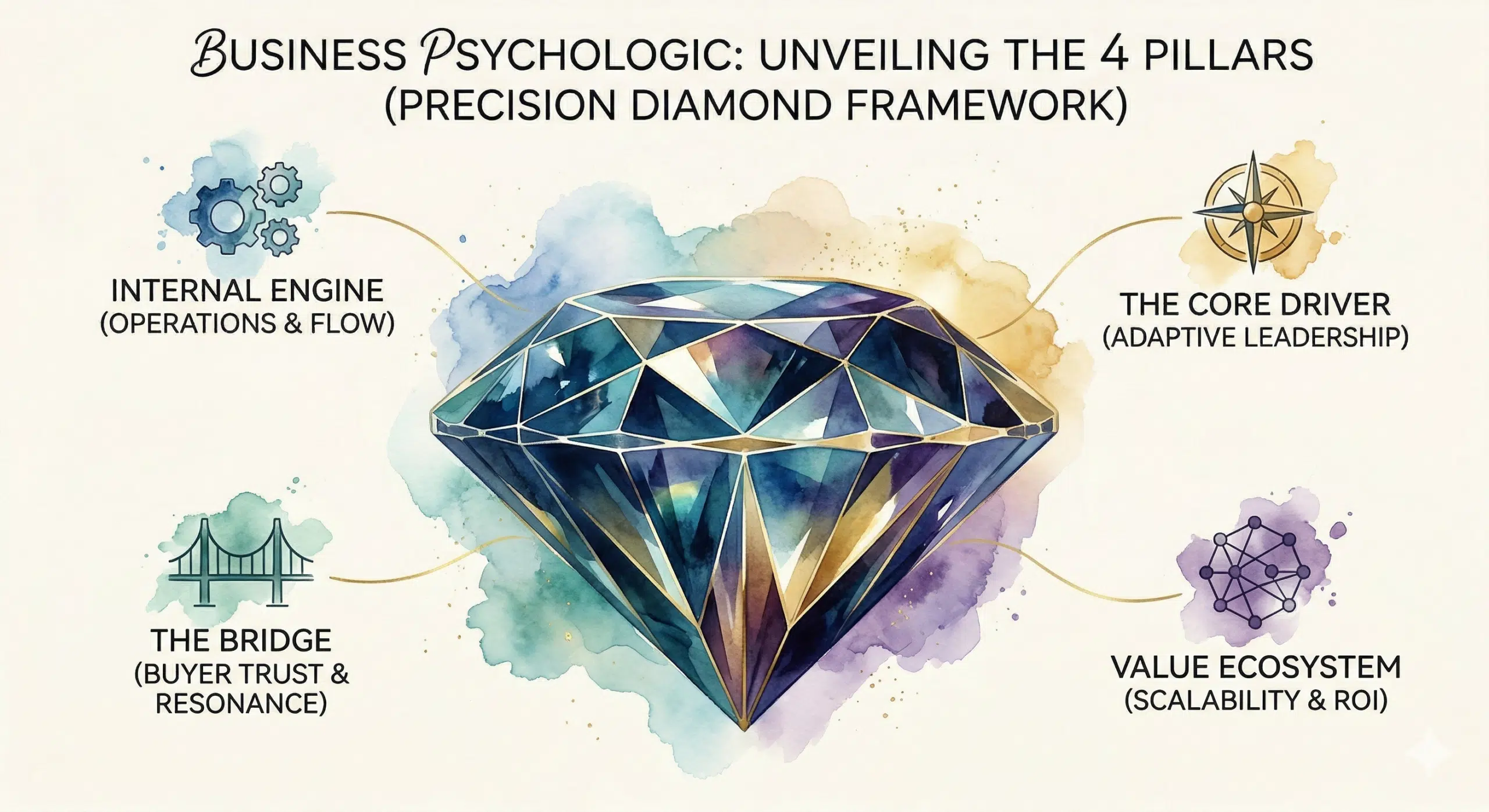
How to close the gap between your vision and the actual execution?
Most businesses do not fail because the strategy is wrong. They fail because the promise, the delivery, the leadership behavior, and the AI workflows do not line up. Business PsychoLogic…