
As a C-level decision maker, your job is to adapt your business to the new global market reality. My job, meanwhile, is to preserve the productivity, effectiveness, and efficiency of your human systems by exploring and adapting to the way people actually think, make decisions, work, and buy. Here is what we see in my company for the past 12 months of hectic crisis management.
AI is a must-have tool, but we need to manage the risks in order to prevent the attrition of senior leaders, who get burned in the process and they will pay the actual prices of this new era of transformation, as I discussed in the previous article, dedicated to the human vulnerability of the modern “everyday invisible heroes”.
If you “don’t have time” to read this, you are already in the danger zone. Stop making excuses. Growth happens outside your comfort zone. We’re here to support you every step of the way, because #YouMatter.
- Enterprises are rushing to declare victory in the AI revolution
- The industry narrative is loud and clear: AI is the new engine of growth
- The "Productivity" Trap: Theoretical vs. Proven
- The "Intern" Problem: Scaling Chaos
- The Disconnect: Executive Narrative vs. Workforce Reality
- Is This the Next Tech Bubble?
- How to Avoid the Crash: A "Human2Human" AI Strategy
- Respect the Human System:
- My story ends here. But yours only begins
- The Path Forward
- Take Our Psychological Test for Burnout Prevention
- Our customers' TOP 10 questions
- Who are We
Enterprises are rushing to declare victory in the AI revolution
What is the real human cost of integrating AI into everyday business life? Is there a disconnection between strategy (the brain) and execution (the hands)?
The $3.70 Illusion: What the Data Really Says About Your AI Transformation
Two years ago, the promise was simple: AI would be the pressure valve for overwhelmed contact center agents, sales experts, and PR professionals. The narrative was that AI would handle the mundane tasks, minimize cognitive overload, and act as a “super-assistant”—organizing, structuring, and spreading messages while building a “reading box” to navigate complex inboxes.
We bought the dream. We expected a calm, efficient future.
Reports like IDC’s latest figures suggest a golden era: companies are allegedly reaping almost $4 for every $1 invested in generative AI.
The narrative is seductive—organizations are moving confidently from experimentation to transformation, with promises that Agentic AI could double workforce productivity by 2027. Behind these glowing forecasts and the marketing momentum, a dangerous disconnect is widening between C-suite optimism and the frontline reality.
But let’s be brutally honest in the Boardroom.
The reality in 2025 is a silent panic. Instead of relief, agents are reporting higher levels of stress, sleep disruption, and daily burnout.
The tool meant to save us is creating a new form of invisible labor that is harder on the human brain than the work it replaced.
Are we measuring actual value, or are we confusing speed of output with quality of outcome?
Here’s why your ROI calculations might be setting your organization up for failure, and why the ‘productivity miracle’ might be an illusion. Don’t get me wrong — AI is a game changer for all of us — but the real power lies in the human systems that run the operations, not the AI itself.
The industry narrative is loud and clear: AI is the new engine of growth
According to the latest IDC research, organizations are seeing an average return of $3.70 for every $1 invested in Generative AI.
But looking closer at the data reveals a different story—one of operational friction and human cost:
- The “Pilot Purgatory”: While firms run an average of 37 AI pilots, only 5 ever survive to reach production.
- The Alignment Gap: A staggering 40% of companies lack close alignment between business and IT.
- The Scramble: 51% of enterprises are still in the “Opportunistic” stage—reacting with disconnected experiments rather than a managed strategy.
The Psychological Translation:
As a Business Psychologist, I see what these numbers hide. That “gap” isn’t just an operational inefficiency; it is the sound of your human systems breaking. The “scramble” to scale AI without alignment is creating a massive Hidden Debt—paid for by the burnout and cognitive overload of your best people.
Read the full IDC report for the benchmarks. Read my analysis below for the human reality that we need to acknowledge and respect.
The “Productivity” Trap: Theoretical vs. Proven
We are currently measuring AI success by the wrong metric: Volume.
We celebrate that AI can generate a report in seconds or code in minutes.
But speed is not productivity.
The Hidden Cost:
When AI generates “fast” content, it forces your high-value employees to shift from Creators to Verifiers.
This “Black Box” problem is the root cause of the burnout. Because the AI’s logic is hidden, we cannot trust it. This forces the human user to spend their mental energy not on creating, but on verifying the AI’s output.
You’re no longer just doing your job; you’re doing the second, invisible job of auditing a machine. This “verification burden” is the single biggest source of AI-related cognitive load.

The Reality:
Your teams are experiencing “The Panic Before the Send Button.” They are spending hours fact-checking, tone-policing, and correcting AI hallucinations. This is Invisible Labor. It doesn’t show up on your P&L, but it bleeds cognitive energy from your workforce.
The Risk:
You aren’t getting $4 back. You are getting $4 worth of noise that requires $5 worth of human attention to filter.
We are tired. We are overworked. When AI offers to do the heavy lifting, our brain craves that moment of relief. We outsource the task to avoid the pain of creation. For many, it also soothes the Imposter Syndrome—“The machine is smarter/faster than me, so I’ll hide behind it.”
It feels like a break. But it is a trap. We trade the effort of creation for the anxiety of verification. We aren’t resting; we are maintaining a state of chronic hyper-vigilance:
- From the outside (the Objective Reality), the metrics look great. Emails are drafted in seconds. Call summaries are instant. Volume is up.
- But internally (the Subjective Reality), the human agent is drowning in Micro-Decision Overload.
We lose our grit because we stop exercising the muscle of doing the work, yet we are more exhausted than ever because managing a hallucinating intern is harder than doing the job yourself.
The “Intern” Problem: Scaling Chaos
The hype cycle suggests that Agentic AI acts like a senior consultant. In reality, it often performs like a hyper-active intern.
Data Quality Gaps:
If you implement “intelligent automation” across a workforce without first addressing issues such as data quality, process alignment, business logic and governance, you won’t achieve greater efficiency.
You are scaling chaos.
If your internal data is unstructured or biased, AI amplifies those flaws at a speed humans cannot catch.
The Governance Debt:
Companies are embedding AI faster than they can ensure ethical safeguards.
We are building a “Black Box” infrastructure where no one quite knows why a decision was made, only that it was made fast. This is a compliance time bomb waiting to explode.
The Disconnect: Executive Narrative vs. Workforce Reality
This is the most dangerous gap, so we aim to raise awareness and encourage C-level decision makers to take responsibility for peak performance, overall productivity and the health of their human systems.
In the C-Suite the narrative is “Efficiency,” “Automation,” and “Headcount reduction.”
On the Frontline the reality is “Cognitive Overload,” “Surveillance Anxiety,” and “Fragmented Focus.”
Your humans are not resisting AI because they are lazy. They are resisting because the implementation often ignores their Human Operating System. When you interrupt a human’s deep work with constant AI-driven prompts and “nudges,” you break their flow. You lose the Deep Work necessary for complex problem-solving—the one thing AI cannot do.
Instead of making one big decision (“I will write to the client”), the human agent now has to make 20 micro-decisions to validate the AI’s work. And if they are interrupted—by a phone call or a colleague—the cost is catastrophic. When you are writing your own thoughts, you can pick up where you left off. When you are editing AI, the interruption breaks the connection completely. You forget the AI’s “intention” (because it never had one), and you have to start the cognitive process from zero.
Human creativity, innovativeness and productivity require quiet spaces where we can withdraw and work our magic. Now, however, we observe that this natural process is undergoing a shift in form: leaders are depleting their mental resources in order to do the job, deliver the expected quality and train/supervise the AI at the top of their game.
When a human writes an email from scratch, they follow a linear train of thought. It flows from their intention to their fingers. When AI generates an email, the human is forced to reverse-engineer logic they didn’t create. They have to become an instant editor, fact-checker, and tone-analyst.
Is This the Next Tech Bubble?
We must ask the uncomfortable question: Are we overestimating the short-term ROI of generative AI?
History is full of “productivity revolutions” that led to bubbles before they led to value. If your “Agentic AI” strategy relies on replacing human judgment rather than augmenting it, you are likely heading for a disillusionment trough.
True value doesn’t come from replacing the human; it comes from removing the friction that stops the human from being brilliant.
AI has immense processing power, and it is likely that our current generation of leaders is sacrificing their own safety for our progress.
We still don’t know the true cost of this global transformation, but we must take better care of those who exhaust themselves in pursuit of success.
We realize the moment we see the “perfect” AI draft that it is hollow. It lacks the Human2Human spark. Is it easier to understand whether the “finished email” matches our personal mission? No. It is harder. Because now we are fighting a template that looks correct on the surface but feels wrong in the soul.
How to Avoid the Crash: A “Human2Human” AI Strategy
We must stop treating humans like faster modems.
In order to transform this ‘hidden debt’ into genuine value, C-level leaders must reconsider the roadmap. Here is a framework for re-humanizing the business system:
1. Stop Measuring Output, Start Measuring Outcome:
Don’t ask “How much faster did we write the code?” Ask “Did the code require less rework?” Don’t ask “How many emails did we send?” Ask “Did our client trust increase?”
Companies are terrified of being left behind, so they are throwing money at AI tools without a plan. They are “scrambling” to buy the technology before they even know what problem they are trying to solve. The Psychological translation here is: This is organizational FOMO (Fear Of Missing Out) driving impulsive decisions.
2. Acknowledge the Invisible Labor:
Look for the hidden hours your teams spend “fixing” AI. That is a cost you must factor into your $4 return. Consider your tech teams, for example. They care about code, infrastructure and ensuring that the software runs smoothly. They often fail to see why the business needs this particular tool.
Stop measuring success only by “speed to send.” Start measuring the cognitive load required to verify AI outputs.
3. Prioritize Data Hygiene over Speed:
You cannot build a skyscraper on a swamp. Fix your the business processes and infrastructure before you unleash Agentic AI, or you will simply automate your own confusion and chaos.
4. Restore the “Sanctuary” and “Touch Points” in communication:
For your human agents (especially Introverts/HSPs), build in tech-free zones. Allow them to write important communications from scratch to reconnect with their own voice.
Don’t let AI handle all the “easy” communication. Extroverts need human touchpoints to recharge. Let them pick up the phone instead of sending an AI email.
5. Train for Intention, Not Just Prompting:
Teach your teams that they are the master of intention. If the AI draft drifts from their values, teach them to scrap it immediately rather than wasting energy trying to “fix” a broken logic.
Respect the Human System:
AI is a tool, not a savior. Integrate it in a way that respects human cognitive limits. Give your people “Sanctuaries”—AI-free zones for deep thinking—so they can maintain the strategic oversight required to manage these powerful tools.
The failure of AI transformation is not a technology problem; it is a Human Systems problem. The gap exists because there is no Human2Human translation between the C-Suite’s vision and how the department executes it.
Your pitch to C-Levels: “You don’t need more software; you need a translator. You are part of the 40% where IT and Strategy aren’t speaking the same language. I fix the Human System so the AI System can actually work.”
Don’t let the hype cycle drive your strategy.
The future belongs to organizations that master the synergy between Artificial Intelligence and Human Wisdom—not those who try to replace one with the other.
My story ends here. But yours only begins
You already know what must be done.
Now, for you, it’s time to close this story and to start writing your own.
And for me, it’s time to stay silent and to wait and listen to the stories of humans who are not afraid to reinvent themselves over and over again.
The Path Forward
We can’t change the times. And my job is not to talk about whether you should or shouldn’t make a life or business choice. My job is to educate and empower people on how to use the modern tools, ways, and ideas for proper self-leadership and development without harming themselves or others.
I will show you how the modern trends continue to develop in personal, organizational, business, and market settings by following the simple rule:
The most important resource for your success is YOU!
Be an ocean in a drop.
Change. Adapt. Evolve.
FREE OF CHARGE RESOURCE:
Take Our Psychological Test for Burnout Prevention
Burn With a Bright Flame, Not Out!
Our free psychological test is design to help you assess your resilience, effectiveness under pressure, and ability to stay calm and productive. Answer each question with a quick ‘Yes’ or ‘No’—there’s no right or wrong response, just insight into your unique experience. If your inner strength feels low, consider seeking support.

Our Newsletter:
Enhance Your Business Systems
Get free training, CEO interviews, and insights—stay connected while you await a spot on our waiting list. We optimize processes, operations, and tech solutions, connecting you with the right people.
Confidentiality is our priority. Strict NDAs protect our clients’ unique strategies, while valuable insights and knowledge are shared in case studies delivered straight to your inbox.
Let’s transform your ideas from the inside out.
FAQ SECTION:
Our customers’ TOP 10 questions

OUR TEAM:
Who are We
THEY BELIEVED IN US
The Library of Shared Stories

So talented and dedicated!
I wish everyone the pleasure of working with Juls.

During our meetings she helped me to clarify my overall concept, to structure my business strategy, to gain confidence and to see the sense of what I do in a new way. She inspires me.
Thank you, Julika, for the valuable advice and warm support!

Thanks to people like you, I believe in the goodness and purpose of myself! I hope I will soon be resourceful enough to be useful and helpful like you! Thank you for your understanding and patience!
See you soon!
I am blessed to have found you and grateful to have you! I can already say from experience that with your help, people who trust you run their marathon of personal and professional growth more easily and confidently!
I am very grateful for your patience with me!

I came with the following expectations: personal support,
guidance on what to work on.
I left with the satisfaction of your ideas, the path laid out, the tasks on a personal level. I feel more energized, with more
inspiration, with more self-confidence. Greetings! Beautiful day!

OUR CUSTOMERS:
Client Success Stories

We are proud of our 15-year track record of success. While we don’t achieve every goal, we’re relentless in pursuing excellence.

We are the innovators you need to turn your business idea into a market disruptor. Make your ideas stand out.

Confidentiality is key to our success. We work under strict NDAs to protect the data and competitive advantages of our clients.
OUR PUBLIC RELATIONS:
Featured In & Our Official Partners
READ MORE PROFESSIONAL ARTICLES:
Grow Your Ideas with Juls’ Psychology
The Fourth Dimension of Business: Why You Can’t Measure AI with Old KPIs
Business psychology isn’t just about finding the “5 Key KPIs” or the “10 Best Practices”…
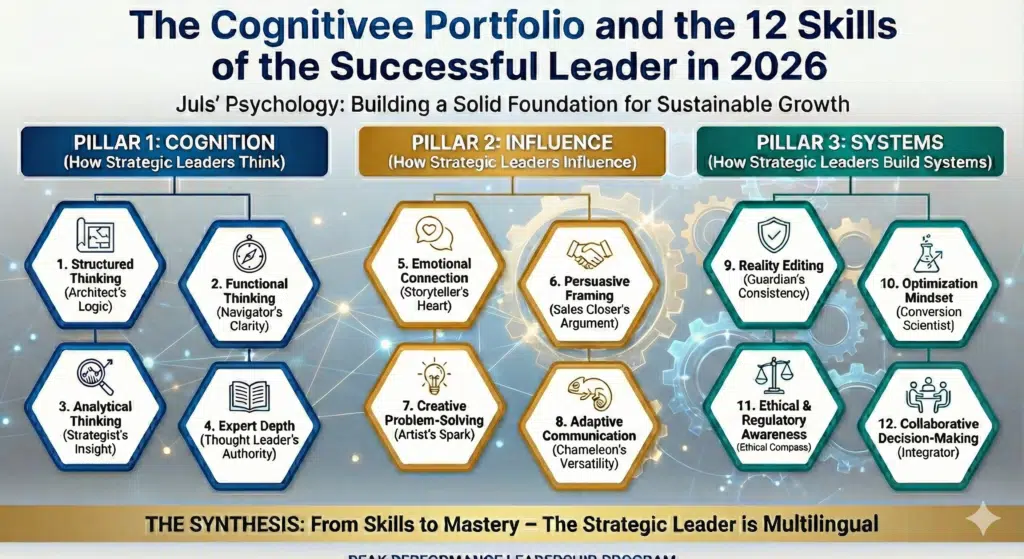
The Cognitive Portfolio and the 12 Skills of the Successful Leader in 2026
At Juls’ Psychology, we take a counter-intuitive approach to this season. For us, Q1 is…

The Life Cycle of a Business: Middle Journey – Part 2
Your Personal Business Training for CEO Mindset! Welcome to Juls’ Psychology guide to navigating the…